
Cash Envelope System: Step-by-Step Guide to Budgeting (2025)
The cash envelope system has been around for decades, yet it remains one of the most effective, practical ways to take control of day-to-day spending. In 2025—an era of contactless payments, instant transfers, and hyper-personalized finance apps—the envelope method still shines because it focuses on behavior. It helps you decide your spending in advance, limits impulse purchases with tactile boundaries, and turns money from an abstract number into a concrete plan you can hold in your hands. Whether you call it the envelope method, cash-stuffing, or a category cash budget, you’ll find that the logic is simple and the results can be profound.
This long-form guide gives you a modern, realistic, and detailed approach to implementing a cash envelope budgeting system in 2025. You’ll learn the classic foundation, effective digital and hybrid options, and practical strategies for everything from groceries and gas to irregular income, debt payoff, and family finances. Think of it as a full playbook—part behavior design, part budget math, all action.
Why the Envelope System Works (Even in 2025)
Money management isn’t purely logical—it’s behavioral. The cash envelope method works because it introduces healthy friction. Swiping a card offers little feedback; physically handing over cash from a labeled envelope makes you pause. That pause is powerful. It helps you stick to your plans without relying on willpower alone.
- Pre-commitment: You assign cash to categories before you shop, not after.
- Visual limits: Seeing an envelope thin out changes decisions in real time.
- Immediate feedback: Overspending isn’t hidden—it’s tangible and timely.
- Emotionally balanced spending: When you plan fun money, treats feel guilt-free.
- Simplicity: Clarity beats complexity when cash flow is tight or unpredictable.
While many people prefer cards or tap-to-pay, you can still capture these benefits using digital envelope alternatives like bank sub-accounts and app-based “virtual envelopes.” The universal principle remains: give every dollar a job and confine spending to job-bound funds.
The Envelope System in One Page
- Create spending categories you can realistically manage with cash or virtual envelopes.
- Assign a monthly or per-paycheck amount to each category based on your priorities and constraints.
- Withdraw cash (or transfer to sub-accounts) and “stuff” the envelopes.
- Spend only from the appropriate envelope; when it’s empty, you’re done for that period.
- Review and tune amounts each cycle; roll forward leftovers or reallocate thoughtfully.
That’s the system. What follows is a thorough, step-by-step playbook to do it right.
Step-by-Step: Setting Up Your Cash Envelope Budget
Step 1: Map Your Income and Cadence
Start by listing your income sources and timing: weekly, biweekly, semi-monthly, monthly, or irregular. The envelope method aligns beautifully with paycheck-based budgeting—you’ll stuff envelopes on payday and limit spending until the next paycheck.
- Predictable income: Use the actual dates and amounts from your payroll schedule.
- Variable income: Base your plan on a conservative monthly baseline (e.g., your 3–6 month average) and adjust envelopes as funds arrive.
Step 2: List Your Non-Negotiables
Identify bills that should be paid electronically for safety and record-keeping: rent or mortgage, utilities, insurance, debt payments. These aren’t usually cash envelopes; they’re electronic commitments. If you wish, you can still create “paper envelopes” as visual placeholders for these amounts in your binder to reinforce the habit of giving every dollar a job.
Step 3: Choose Your Cash-Friendly Categories
These are the best fits for the cash budgeting envelope system because they can fluctuate and benefit from tangible limits:
- Groceries
- Dining out / Coffee
- Gas / Transit / Rideshare
- Household items (cleaners, toiletries)
- Personal spending (allowances, beauty)
- Entertainment / Fun money
- Gifts / Holidays
- Kids / Pets
- Miscellaneous cushion
Consider “semi-fixed” categories like health copays or parking if cash works better for you. And don’t forget sinking funds: savings envelopes for near-term expenses like car maintenance, annual subscriptions, travel, back-to-school, and medical deductibles.
Step 4: Set Target Amounts
Tally your net income for the cycle, subtract fixed bills and minimum debt payments, and allocate the remainder to envelopes. This creates a zero-based budget: income − expenses − savings = 0. Every dollar gets a job.
- Start with essentials (food, fuel, medicine).
- Fund obligations (childcare, alimony, transit pass).
- Allocate to sinking funds to prevent “surprise” expenses.
- Add fun money last—it’s important, but not more than the essentials.
Step 5: Prepare Your Envelopes
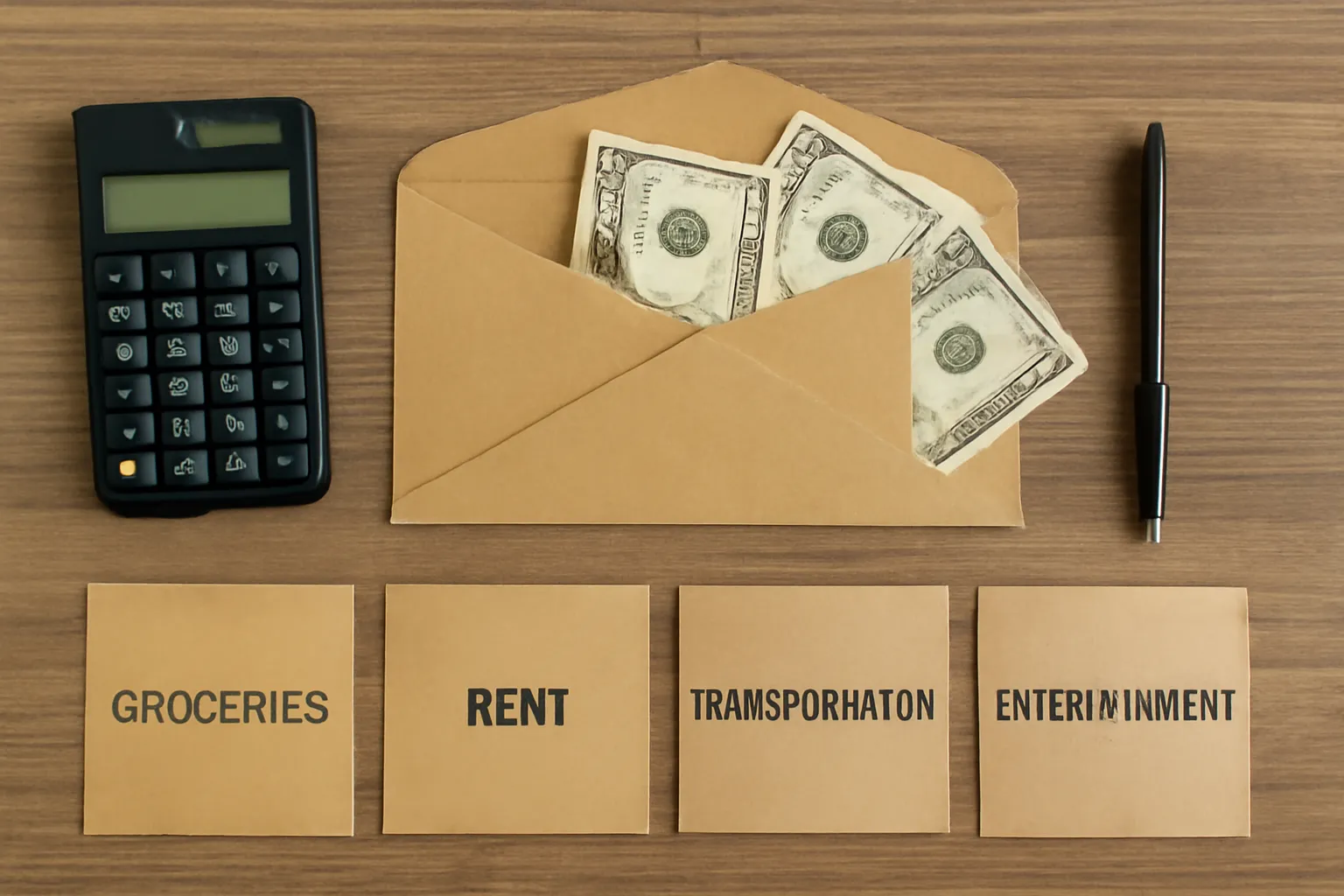
Label physical envelopes or use a cash-stuffing binder. If you prefer digital, create bank sub-accounts or app categories. Color-code or use icons for quick recognition. Keep a simple ledger line inside each envelope to track deposits and purchases.
Step 6: Stuff on Schedule
On every payday, withdraw the planned cash. Immediately sort into envelopes—no detours. If you’re running a hybrid envelope system, transfer funds to sub-accounts and note the new balances in your ledger or app.
Step 7: Spend Only from the Right Envelope
If you’re buying groceries, use the groceries envelope. Doing so forces small, smart trade-offs (store brand vs. name brand, or skipping extras). If the envelope empties early, that’s an early warning: adjust behavior, borrow from another envelope deliberately, or pause spending. The feeling of scarcity now helps avoid real scarcity later.
Step 8: Reconcile and Review Weekly
Once a week, total the remaining cash by envelope. Adjust plans for the rest of the cycle. This weekly money check-in keeps you proactive instead of reactive. At month-end, reflect: What worked? Where did you underfund? What category needs more or less next cycle?
Building Your Category List the Smart Way
Keep It Manageable
Too many envelopes becomes clutter. Aim for 5–10 active spending envelopes plus a handful of sinking funds. You can use a “miscellaneous” envelope for rare odds and ends to reduce complexity.
Anchor Categories to Real Decisions
Every envelope should correspond to a real spending decision point, not just a line in a spreadsheet. For example, “Meal prep” vs. “Dining out” could be separate if they balance each other; when dining out goes up, meal prep goes down.
Sinking Funds: Your Future-Proofing Tool
Sinking funds are the envelope system’s superpower. They turn “unexpected” costs into planned events. Examples:
- Car maintenance: $75/month → Oil changes, tires, repairs
- Annual subscriptions: $20/month → Streaming, cloud storage
- Travel: $100/month → Yearly trip or long weekends
- Back-to-school: $25/month → Supplies, shoes
- Medical: $50/month → Copays, medications
The key is to fund them every cycle, even modestly, so you stop raiding your emergency fund for routine expenses.
How Much to Put in Each Envelope
Use past spending to guide your targets. If you don’t have records, make your best estimate and practice iteration. Consider:
- Household size and dietary needs (groceries).
- Commute distance and fuel prices (gas).
- Work/life rhythm (coffee, dining out, childcare).
- Seasonality (heating, gifts, school events).
A practical approach is the 50/30/20 baseline for monthly income: roughly 50% needs, 30% wants, 20% saving/debt payoff. Adapt it: the envelope system is about conscious trade-offs, not rigid ratios.
Example Monthly Allocation (Net Income $4,000)
- Fixed bills (electronic): $2,200
- Groceries (cash): $600
- Gas/Transit (cash): $250
- Dining/Drinks (cash): $200
- Household (cash): $120
- Personal/Fun (cash): $160
- Kids/Pets (cash): $120
- Sinking funds (mixed): $200
- Debt payoff extra (electronic): $150
This plan deliberately overfunds variable categories early to avoid end-of-month crises. As you learn, you might tighten any category and redirect money to goals.
Irregular or Variable Income: Envelope Tactics That Work
If you freelance, run a small business, or have seasonal swings, embrace a baseline budget:
- Calculate your 3–6 month average take-home.
- Set a bare-minimum budget that you can cover with 80–90% of that average.
- Stuff envelopes for essentials and modest sinking funds first.
- When income exceeds baseline, allocate the surplus deliberately: top off sinking funds, increase debt payoff, or pre-fund next month’s envelopes.
The aim is to smooth chaos. Build a small Income Buffer envelope—one to two weeks of expenses—so a slow month doesn’t derail your plan.
Going Digital: 2025-Friendly Envelope Alternatives
Many people prefer not to carry cash. You can still practice the envelope budgeting method digitally:
- Bank sub-accounts or “spaces”: Create named buckets (Groceries, Gas, Fun). Move money in on payday and pay bills or use a debit card linked to the main account. Manually track spending against each bucket in an app or sheet.
- Prepaid cards per category: Load a set amount for high-risk overspend areas (e.g., dining out). When it’s empty, it’s done.
- Budgeting apps with virtual envelopes: Assign funds to categories. Strong options now integrate with open banking to auto-categorize, while you still enforce the rule: spend only what’s assigned.